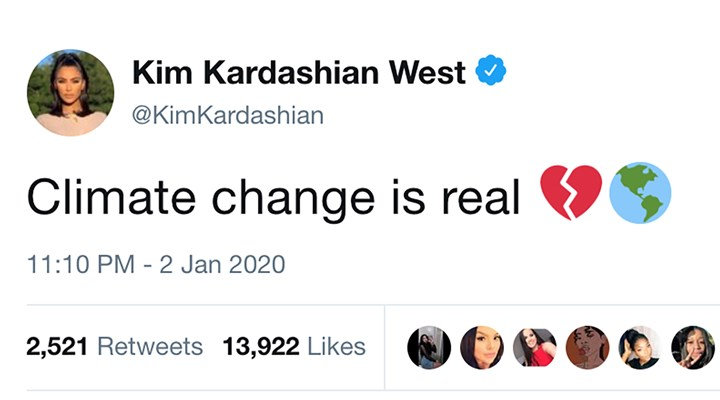
The image you have just seen is me trying to make a joke, mainly. I say mainly because it is extremely hilarious that Kim Kardashian, widely known for her life of luxury and with no past and current regard for the environment, is the one tweeting such a “duh” claim.
It is also funny because she thought she was making a change. I actually have no knowledge of if she is behind any policies that are trying to fight climate change, since she went into Law and all that jazz—but she is no Greta Thunberg. The thing is: no change was made.
And climate change is still real. It is still going on, and it is declining fast.
All this talk about climate change is happening because I attended a talk on climate change by Alice Evatt, PHD student at the University of Oxford, which, of course, had the desired effect of making me think about the impending climate disaster that we could face if we—and pardon my language—do not get our shit together.
Evatt presented us with interesting points about how emergencies (of any kind) make us forget about blame, and responsibilities, and pointing fingers, and directly snap us into action. Imagine you have just accidentally been ran over by a rushing biker on the street: you collide with them, the impact is awful, and your knee is in such a bad state that you can almost see the bone poking out (sorry for the imagery). But my point (and Alice’s) was that if you have a bone poking out of you, your last thought is going to be “who did this to me?”. You are going to be much more focused on getting rushed to the hospital so that bone can go back to its rightful place: inside.
To make this image make sense: we, as in the planet Earth and everyone living in it, are the pedestrian with the screwed knee. We are in an estate of emergency, of climate decline. So our focus, now more than ever, should shift from responsibility to action in the same way we would do in a situation like the previously mentioned. It is not easy to do it, though. It is much more simple to start pointing finger and demanding action—instead of acting ourselves—from the people that are behind the rapidly worsening environmental crisis. Capitalism, yes. Magnates, yes. Kim Kardashian, yes, probably, along with a million other celebrities.
But there are other measures taking place, or waiting to take place, that could help slow down climate change. Alice Evatt went into depth about these measures and how it is better that they are implemented as soon as possible, as they would be easier, more lenient on people, more justifiable to impose than others. Reducing carbon print is all of those. However, if we go past the point where reducing our carbon print is not enough, harsher measures (for all of us) could, and probably should, be implemented.
I am doing a really bad job at paraphrasing all that she said in the 1-hour lecture provided by the Department of Philosophy, but the core of the seminar basically was: climate change is an emergency (thank you Kim Kardashian), let’s act on it.
But the thought of the world ending in extremely painful and unbearable conditions for humans is fairly anxiety inducing. It is understandable that people would not really know how to act, even if we know we have to. This idea is greatly shown in Weather, by Jenny Offill, a postmodernist novel about what it means to be a normal person plagued by the worry of an impending climate disaster.
It was a series of coincidences—me having to read Weather for class, then attending Evatt’s talk, then rereading the very Sally Rooney book that mentions climate change at the same time I was doing all of those things, me being an anxious person myself—that led me to decide on an unexpected MA thesis topic: different literary responses to the climate crisis.
But I will tell you all about that on the next blog post, shall I?